Completions

This paper aims to establish a set of best practices for generating particle-size-distribution data from core samples.

This paper discusses the successful execution of two openhole gravel-pack completions in two Gulf of Mexico fields with depleted reservoirs.

By integrating experimental and mathematical modeling approaches, this work aims to advance the understanding of sand-detachment dynamics and formation instability under varying saturation conditions.
-
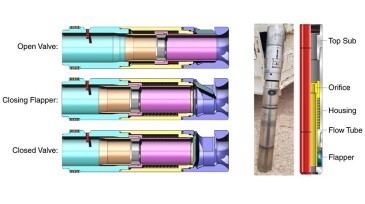
 To enable a fully interventionless approach, a barrier-rated tubing-hanger valve has been developed to eliminate slickline intervention and minimize associated risks and operational time.
 -
This paper aims to present thoroughly the application of subsurface safety injection valves in extremely high-temperature environments.
-
Advanced tracer technology was deployed in Oklahoma to analyze production across lateral well sections.
-
After 5 years of in-depth diagnostic research, the Oklahoma City-based operator shares more insights on fracture behavior.
-
This paper introduces a novel optimization framework to address CO2 injection strategies under geomechanical risks using a Fourier neural operator-based deep-learning model.
-
The technology, which uses Industrial Internet of Things components, aims to reduce the costs and improve the safety of drilling operations.
-
This paper discusses the development of a multientry, multistage fracturing system and its advantages over traditional openhole multistage fracturing solutions.
-
Few things are more essential to the now global hydraulic fracturing revolution than access to fresh water, yet this dependency use has raised environmental concerns and operational challenges.
-
Field examples of operators using chemical restimulation to boost production in aging unconventional wells as an alternative to acid treatments.
-
In the Marcellus, Repsol is slicing and dicing legacy data to evolve its completions strategy, while in the Permian, ExxonMobil is mastering the 4-mile lateral drillout using lessons learned.