Completions

This edition highlights three offshore technology papers that address a common industry theme: how targeted engineering solutions can reduce uncertainty, shorten operations, and make technically constrained offshore well activities more executable.

Three papers are highlighted as the primary contributions because of their broad industry relevance. They focus on improving formation particle-size characterization, expanding the application of openhole gravel packs in depleted and compartmentalized reservoirs, and advancing the understanding of capillary pressure in sand production.

This paper aims to establish a set of best practices for generating particle-size-distribution data from core samples.
-
 The newly formed SPE Hydraulic Fracturing Technical Section is working on a project to identify a set of best practices for completions engineers. Once completed, they will be accessible to the entire SPE technical community.
 -
Mixing dry polymer powder and water to make friction reducer as needed during fracturing can cut the cost of the additive and the testing of whether a drastically simplified recipe performs as well as more-complex mixes.
-
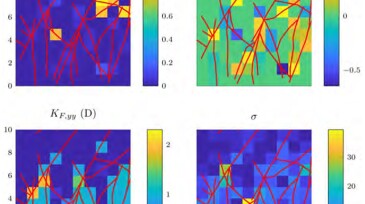
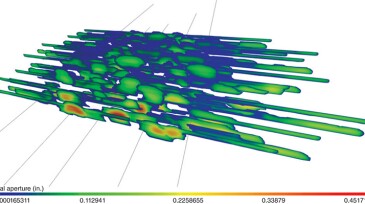
This paper analyzes several configurations of convolutional neural networks suited for predicting upscaled fracture permeabilities and shape factors required to close a dual porosity/dual permeability model.
-
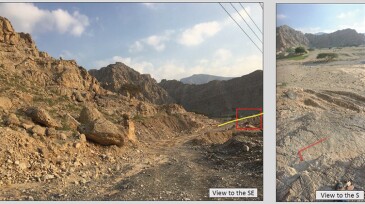
The authors write that simple and straightforward observations on outcrops can be used to build 3D models that mimic geological relationships accurately.
-
In this paper, a complete safety-management approach and a contingency plan are developed for carbon dioxide waterless fracturing operations.
-
This paper presents an integrated work flow to model mechanical properties at sufficiently high resolution to honor accurately rock fabric and its effects on height and complexity and, thus, production.
-
In the past decades, the success of unconventional hydrocarbon resource development can be attributed primarily to the improved understanding of fracture systems, including both hydraulically induced fractures and natural fracture networks. To tackle the fracture characterization problem, several recent papers have provided novel insight into fracture modeling techniq…
-
Insights from an ongoing industry study on North American shale wells help explain what frac hits, or fracture-driven interactions, are doing between offset wells, and why.
-
SponsoredShell needed an easy-to-use, simple well monitoring solution. Could an IoT wireless solution measure up to a classic wired approach?
-
The pressure pumping business has been looking up this year, but the price paid to buy a big player in that business, FTS International, suggests growth may not last.