Formation evaluation

Canada’s development of large-scale digital drilling core libraries and open geoscience data platforms follows approaches pioneered in Australia, particularly Western Australia, through decades of government investment in geoscience data collection and preservation.
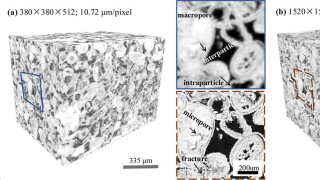
Imaging carbonate rocks at high resolution without losing scale has long been a challenge. A novel framework is introduced that enables accurate super-resolution and extrapolation of carbonate rock images, enhancing micro-CT images while preserving mineralogical and topological features for more reliable pore-scale analysis and flow simulations.

This paper presents an experiment investigating dissolution of basaltic primary minerals and conditions favorable for secondary phase formation under deep subsurface storage conditions.
-
 Building up the world’s hydrogen base will need technological breakthroughs and a lot of new demand. But to store it, the world needs reservoir engineers and other subsurface experts.
 -
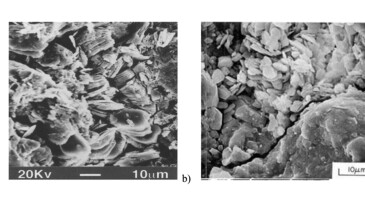
The authors of this paper present a laboratory-based model to determine the detachment of authigenic and detrital particles in formation damage.
-
The authors of this paper introduce a physics-based method for explicit pore-pressure prediction in naturally fractured shale petroleum reservoirs.
-
The authors of this paper aim to identify the effect of various geologic controls on hydrocarbon maturation in the Delaware Basin by restoring regional cross sections and performing simulations of organic-matter maturity.
-
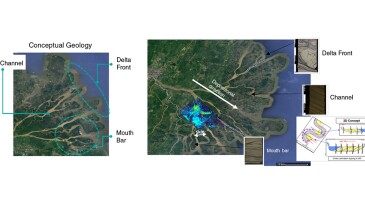
The goal of this paper is to improve the understanding of uncertainties affecting well performance and reservoir connectivity in an offshore Malaysian field.
-
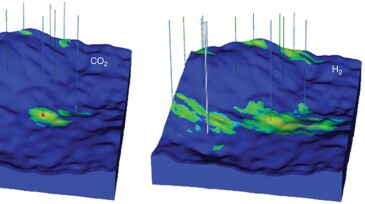
A critical challenge for those designing carbon dioxide storage sites is predicting where the injected gas will go. One of the only sure bets is to assume that any model of a gas plume that looks symmetrical is likely wrong.
-
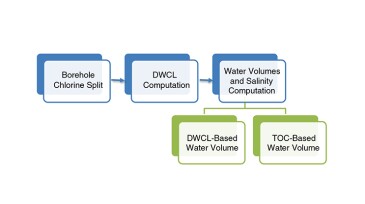
This paper provides a work flow based on research in two methodologies to estimate formation-water salinity, enhancing the quality of saturation evaluation for quick decision-making during logging operations.
-
This paper presents a mathematical analysis of how incorrect estimates of initial reservoir pressure may affect rate-transient analysis in ultralow-permeability reservoirs.
-
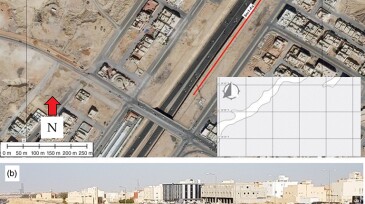
The authors describe an integrated multiscale data methodology involving machine-leaning tools applied to the Late Jurassic Upper Jubaila formation outcrop data.
-
The authors describe a logging-while-drilling nuclear-magnetic-resonance method applied in Bohai Bay, China, as an alternative to radioactive source-porosity measurements.