Reservoir characterization

Known as Arena, the collaboration aims to improve decision-making across increasingly complex reservoirs and growing volumes of subsurface data.

Three papers are highlighted as the primary contributions because of their broad industry relevance. They focus on improving formation particle-size characterization, expanding the application of openhole gravel packs in depleted and compartmentalized reservoirs, and advancing the understanding of capillary pressure in sand production.

By integrating experimental and mathematical modeling approaches, this work aims to advance the understanding of sand-detachment dynamics and formation instability under varying saturation conditions.
-
 This paper will describe how one integrates a comprehensive methodology of data-mining techniques and artificial neural networks (ANNs) in reservoir-petrophysical-properties prediction and regeneration.
 -
Three major finds have shattered assumptions about what is possible in the most explored parts of Alaska’s North Slope.
-
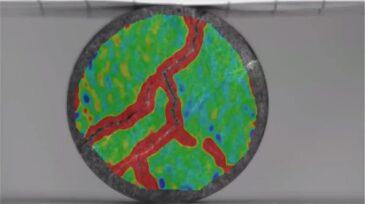
Technology that allows researchers to see stress forming inside rock samples may help unravel some of the mysteries associated with fracture behavior.
-
The authors used a high-quality digital-log data set to characterize reservoir quality accurately in the Niobrara and Codell Formations in the Denver-Julesberg (DJ) Basin.
-
Three-dimensional reservoir models are best created with a combination of well logs and 3D-seismic data. However, the effective integration of these results is not easy because of limited seismic resolution.
-
The paper discusses an approach for predicting the lateral variation of net to gross (NTG) by use of 3D probabilistic seismic inversion.
-
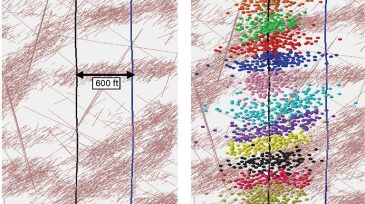
The objective of this study is to validate the concept of using a seismically derived discrete fracture network (DFN) calibrated with borehole measurements, for complex-hydraulic-fracture modeling.
-
The application of high-precision downhole temperature sensors has resulted in pressure-transient analysis (PTA) being complemented or replaced by temperature-transient analysis (TTA).
-
This paper describes the method developed to achieve underbalanced drillstem testing (DST) in a deepwater field offshore India.
-
Carbo Ceramics is making big strides in the use of ceramic proppant.