Reservoir characterization

This paper presents a case study from a mature field redevelopment project where pulsed neutron logging was integrated with advanced reservoir modeling to improve the understanding of fluid-contact dynamics and optimize new horizontal well placement.

This paper aims to showcase examples of how integrated analysis of surveillance data in the Azeri-Chirag-Gunashli field has improved reservoir understanding and informed reservoir-management decisions.

This work applies fuzzy logic, a well-established artificial-intelligence technique, to quantitatively assess connectivity between injectors and producers in a giant presalt field in the Santos Basin of Brazil.
-
 The authors develop an innovative machine-learning method to determine salt structures directly from gravity data.
 -
An appropriate work flow of combining suitable advanced technologies can help to overcome the long-standing challenges of sub-basalt imaging.
-
Most of today’s equipment and interpretation methods are indeed not new. After all, well testing has been around for nearly a century, resulting in a legacy that may not always look cutting-edge, but these tried-and-true tools were so technologically remarkable that they became staples.
-
The work and the provided methodology provide a significant improvement in facies classification.
-
The authors introduce and compare two quality-control approaches based on two different signal-processing practices.
-
Innovators at the Norwegian oil company have developed a machine-learning model that analyzes mud-gas data to predict the gas/oil ratio of wells as they are drilled—something that the industry has worked for decades to accomplish.
-
Eni and IBM developed a cognitive engine exploiting a deep-learning approach to scan documents, searching for basin geology concepts and extracting information about petroleum system elements.
-
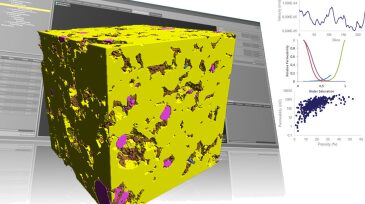
SponsoredThermo Scientific e-Core Software is a unique, high-performance computing platform for the characterization of complex porous media. It focuses on the three essential components of Digital Rock Analysis: parallel computing, multiscale modeling, and process-based reconstruction of 3D volumes.
-
The UK offshore Lancaster field was to prove that complex basement formations could be profitably developed. Instead, it is a reminder of how a long-term production test can drastically alter a reservoir model built upon years of exploration work.
-
Advances during the past decade in using convolutional neural networks for visual recognition of discriminately different objects means that now object recognition can be achieved to a significant extent.