Reservoir simulation

Known as Arena, the collaboration aims to improve decision-making across increasingly complex reservoirs and growing volumes of subsurface data.
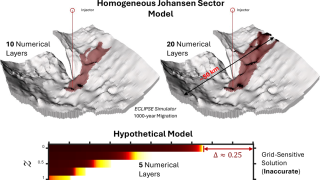
A new framework combines analytical and numerical insights, extending vertical equilibrium modeling and guiding reservoir-scale implementation, providing reservoir engineers with practical guidance for assessing accuracy across flow regimes and long-term carbon-dioxide migration.

This article from the SPE Integrated Reservoir Management Technical Section (IRMTS) examines the closed-loop IRM approach, from insight to execution to learning, and the limits of technology-driven solutions.
-
 The SPE Reservoir Technical Discipline and Advisory Committee invite their Reservoir members worldwide to participate in a new survey aimed at assessing the current state of reservoir engineering across industry and academia. Deadline is 21 July 2025.
 -
This paper presents a fundamental research study with the main objective of building a mechanistic numerical model that captures the important mechanisms of polymer flooding through various mechanistic equations using a combined reservoir flow and geochemical numerical simulator.
-
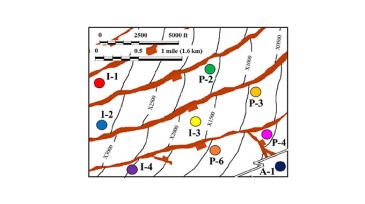
The authors of this paper describe reservoir-fluid-geodynamics processes that explain the reasons behind varying oil compositions and properties within and across different reservoir compartments.
-
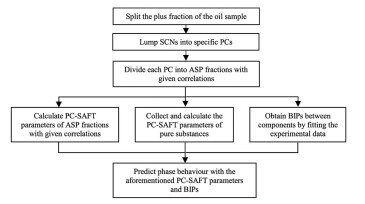
In this work, a perturbed-chain statistical associating fluid theory equation of state has been developed to characterize heavy-oil-associated systems containing polar components and nonpolar components with respect to phase behavior and physical properties.
-
In this study, a deep-neural-network-based workflow with enhanced efficiency and scalability is developed for solving complex history-matching problems.
-
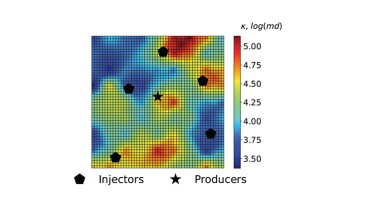
This study presents a production-optimization method that uses a deep-learning-based proxy model for the prediction of state variables and well outputs to solve nonlinearly constrained optimization with geological uncertainty.
-
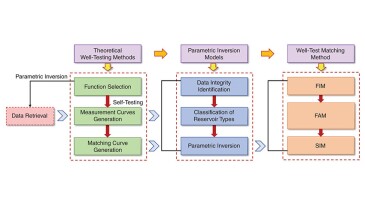
The paper describes a parameter inversion of reservoirs based on featured points, using a semi-iterative well-test-curve-matching approach that addresses problems of imbalanced inversion accuracy and efficiency.
-
This paper introduces a novel optimization framework to address CO2 injection strategies under geomechanical risks using a Fourier neural operator-based deep-learning model.
-
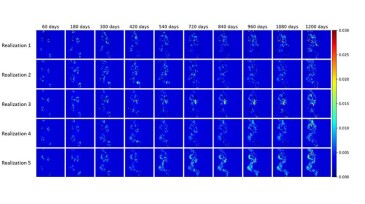
The authors introduce a novel framework combining dynamic mode decomposition, a data-driven model-reduction technique, with direct data assimilation to streamline the calibration of carbon-dioxide plume evolution models.
-
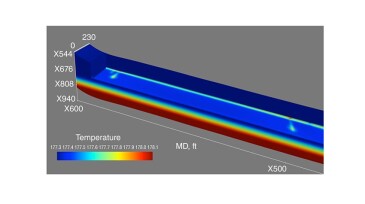
This paper discusses the concept, applications, and continual evolution of a new 3D temperature and spectral-acoustics modeling and logging approach.