Reservoir simulation

This article from the SPE Integrated Reservoir Management Technical Section (IRMTS) examines the closed-loop IRM approach, from insight to execution to learning, and the limits of technology-driven solutions.

This paper presents a case study from a mature field redevelopment project where pulsed neutron logging was integrated with advanced reservoir modeling to improve the understanding of fluid-contact dynamics and optimize new horizontal well placement.

This paper aims to showcase examples of how integrated analysis of surveillance data in the Azeri-Chirag-Gunashli field has improved reservoir understanding and informed reservoir-management decisions.
-
 The authors of this paper present an advanced dual-porosity, dual-permeability (A-DPDK) work flow that leverages benefits of discrete fracture and DPDK modeling approaches.
 -
This study presents a novel approach to screen thermally stable surfactants at high pressures and high temperatures for the explicit purpose of wettability alteration in the operator’s Eagle Ford acreage.
-
The authors of this paper describe a model-driven work flow developed for hydraulic fracturing design and execution that could be a resource for other shale plays with similar challenges worldwide.
-
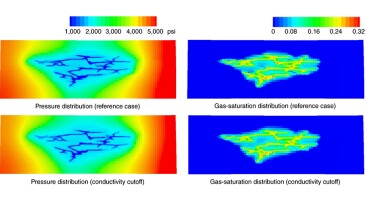
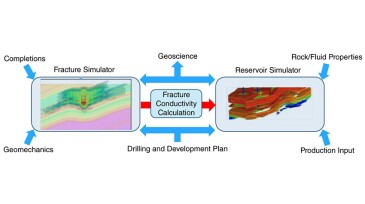
This paper presents a case study of integrated geomechanical and reservoir simulation with a developed fracture conductivity calculation work flow to evaluate well spacing and completions design.
-
The authors of this paper write that computationally coupled models enable swift, accurate, and engineered decision-making for optimal asset development.
-
The authors of this paper describe a procedure that enables fast reconstruction of the entire production data set with multiple missing sections in different variables.
-
This paper presents a physics-assisted deep-learning model to facilitate transfer learning in unconventional reservoirs by integrating the complementary strengths of physics-based and data-driven predictive models.
-
This article presents the application of a reinforcement learning control framework based on the Deep Deterministic Policy Gradient. The crack propagation process is simulated in Abaqus, which is integrated with a reinforcement learning environment to control crack propagation in brittle material. The real-world deployment of the proposed control framework is also dis…
-
Artificial intelligence (AI) and machine learning (ML) technologies have rapidly progressed and have significantly affected traditional reservoir engineering, bringing innovative methodologies to reservoir simulations. However, it is essential to understand that these AI and ML technologies are only as effective and trustworthy as the data they are trained on.
-
This paper describes a work flow that integrates data analysis, machine learning, and artificial intelligence to unlock the potential of large relative permeability databases.