Reservoir

Industry experts at URTeC assessed more than a decade of unconventional growth while discussing where productivity gains will come from next.
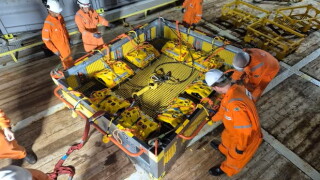
The technology has passed its first phase of qualification, with 84 nodes placed on the seafloor at a depth of 2,000 m to acquire 4D seismic data in the pre-salt Santos Basin.

Chevron and Halliburton describe how they built and deployed the fully autonomous closed-loop fracturing system that enables subsurface-driven optimization.
-
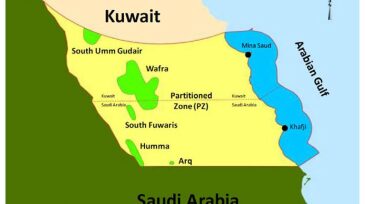
 The First Eocene is a multibillion-barrel heavy-oil carbonate reservoir in the Wafra field, located in the Partitioned Zone between Saudi Arabia and Kuwait. After more than 60 years of primary production, expected recovery is low and provides a good target for enhanced-oil-recovery processes.
 -
This paper studies the technical and economic viability of this EOR technique in Eagle Ford shale reservoirs using natural gas injection, generally after some period of primary depletion, typically through long, hydraulically fractured horizontal-reach wells.
-
This paper presents technologies and best practices to improve oil recovery in mature fields through waterflooding optimization. These technologies have proved practical and cost-effective.
-
This paper presents an interdisciplinary approach to the description of tectonic dislocations made on the basis of interpretation of seismic data, petrophysical analysis of well-logging data in horizontal wells, and inversion of a multifrequency propagation tool.
-
As operators and asset owners worked continually to increase efficiency in oil production, they all realized that part of efficiency improvement is increasing recovery factors. Everybody now is extremely focused on recovering more from the reservoirs they have.
-
This paper provides a robust methodology for miscible CO2 WAG experimental-data acquisition and history matching.
-
This paper describes a case study of the Chonskaya group of fields to demonstrate an approach to the integration of time-domain-electromagnetic (TDEM) electrical and seismic data when building a geological model for improving reservoir-property and -saturation prediction.
-
To the best of the authors’ knowledge, this is the first surface-complexation-based model that describes fully ionic compositional dependence observed in ionically treated waterfloods in both sandstones and carbonates.
-
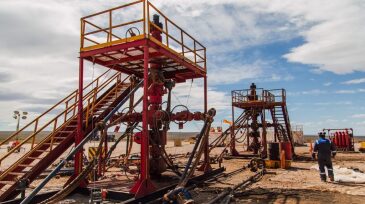
Vaca Muerta production is on the upswing. Will increasing activity propel the Argentine play to the ranks of US shale? Data suggest it is both already there and has a ways to go.
-
Production and proved reserves in the Permian Basin’s Wolfcamp Shale and Bone Spring Formation are reaching new heights, and a new assessment from the US Geological Survey indicates the industry is just scratching the subsurface when it comes to what may be technically recoverable.