Reservoir

The next wave of unconventional growth will likely come from basins in Argentina, the Middle East, Australia, and elsewhere, fueled by expertise gained from shale plays in North America.

Industry experts at URTeC assessed more than a decade of unconventional growth while discussing where productivity gains will come from next.
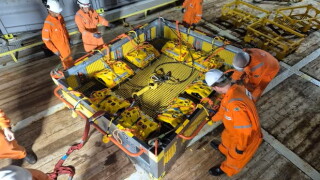
The technology has passed its first phase of qualification, with 84 nodes placed on the seafloor at a depth of 2,000 m to acquire 4D seismic data in the pre-salt Santos Basin.
-
 The label unconventional oil and gas stubbornly hangs on because these formations cannot be understood using the rules of conventional petroleum engineering.
 -
Permanent downhole gauges (PDGs) provide vast amounts of pressure-transient and rate data which may be interpreted with improved pressure-transient-analysis (PTA) approaches to gain more knowledge about reservoir dynamics.
-
This paper focuses on the aspects of proppant selection and adequate fracture-conductivity placement, with the goal of improving well productivity and cumulative recovery.
-
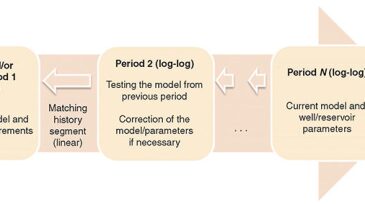
This paper proposes a framework based on proxies and rejection sampling (filtering) to perform multiple history-matching runs with a manageable number of reservoir simulations.
-
This paper provides a more straightforward method for estimating stress-dependent permeability and capillary pressure in rock fractures.
-
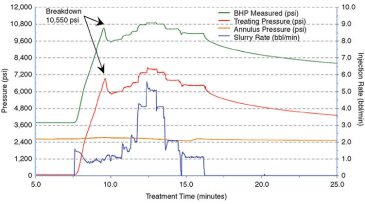
In hydraulic fracturing, the use of diagnostic-fracture-injection tests (DFITs) can provide valuable information.
-
The process of drilling a borehole is very complex, involving surface and downhole drilling systems that interact with the drilling fluid and the surrounding rocks.
-
Enventure Global Technology is working to convince operators that its solid expandable steel liners perform better than chemical diverter agents for refracturing operations. Its technology is called the ESeal ReFrac Liner.
-
The authors discuss the results of a pilot project to capture post-combustion CO2 for purposes of EOR.
-
Comprehensive formation evaluation is one of the technical focus areas that is fundamental across almost all upstream businesses.