Reservoir

Canada’s development of large-scale digital drilling core libraries and open geoscience data platforms follows approaches pioneered in Australia, particularly Western Australia, through decades of government investment in geoscience data collection and preservation.

This study explores the carbon-capture and mineralization potential of ultramafic rock powders when exposed to flue gases generated from combustion of crude oil and mesquite-derived charcoal.

This paper documents the testing, integration, and field deployment of a metal expandable packer used as an openhole toe isolation plug in a deepwater well under high-pressure, high-temperature conditions.
-
 There are no reliable estimates of technically recoverable resources (TRRs) for unconventional reservoirs outside North Amercia, and many countries lack the advanced technology such as horizontal drilling and hydraulic fracturing necessary to develop unconventional resources.
 -
An operator has launched a successful, limited-scope deployment of a nonparametric capability known as event detection and association (EDA).
-
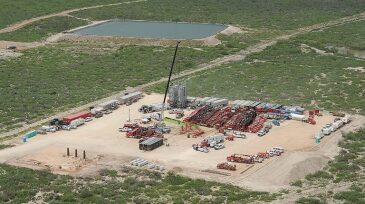
At the Unconventional Resources Technology Conference in Denver, discussion revolved around solving problems below ground and above ground.
-
Hydraulically fracturing and stimulating multiple horizontal wells in sequence has been rapidly adopted by operators because of the potential for production without introducing unwanted risks.
-
The Earth is complex in all directions, and hydrocarbon traps require closure—whether structural or stratigraphic or both—in three dimensions.
-
This paper attempts to describe some of the common problems and to help prevent some common errors often observed in diagnostic fracture injection tests (DFITs) execution and analysis.
-
Analytical tools are useful for reservoir management and can provide simplicity while capturing information derived from events occurring at smaller time scales, which are ordinarily sacrificed in numerical simulations to keep run times reasonable.
-
Understanding well and reservoir performance is the ultimate goal of data gathering.
-
Demand for a better way to remove carbon dioxide (CO2) from natural gas led to the creation of a new material at Rice University in Houston that does something unprecedented on the molecular scale, and might even change gas processing.
-
"Smart water" is needed for effective waterflooding in carbonate reservoirs. A novel water-ionic technology, comprising nanofiltration and reverse-osmosis membrane-based processes, was identified for optimization in this study.