Reservoir

As Egypt’s largest oil and gas investor, Eni is ramping up its 2026–2027 drilling campaign with new investments cross the Mediterranean offshore, Nile Delta, Western Desert, and offshore Sinai to strengthen the country’s role as a regional gas and LNG export hub.

This paper presents an experiment investigating dissolution of basaltic primary minerals and conditions favorable for secondary phase formation under deep subsurface storage conditions.

This study aims to investigate the efficacy of chemical additives strontium chloride and barium hydroxide in accelerating CO₂ trapping mechanisms, their effect on dissolution of carbonate-bearing minerals, and resulting poroelastic changes in the host rock.
-
 Interface Fluidics carved out a niche for itself in the oilfield testing sector a few years ago with a new alternative to coreflooding. Now, along with Equinor, the Calgary-based company is taking on another industry laboratory stalwart: the slimtube test.
 -
The authors introduce and compare two quality-control approaches based on two different signal-processing practices.
-
Innovators at the Norwegian oil company have developed a machine-learning model that analyzes mud-gas data to predict the gas/oil ratio of wells as they are drilled—something that the industry has worked for decades to accomplish.
-
As I reviewed all the SPE seismic papers this time, the most noticeable thing was the diversity of themes and case histories that were covered.
-
In striving to boost production of shale gas and tight oil, China is trying enhanced-hydraulic-fracturing technology and real-time data analysis in the Sichuan shale basin. In Daqing’s tight-oil fields, an alternative fracture-completion strategy and post-stimulation flowback technology has been tested.
-
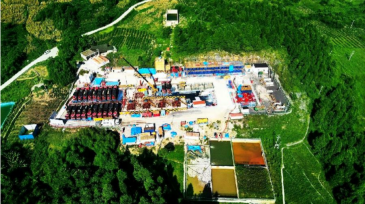
Sinopec is moving on to Phase 2 at its Weirong shale-gas development in Sichuan province after having completed Phase 1 by drilling 56 new wells over the past year and building new infrastructure to support increased natural gas production.
-
An investigation of casing damage led Chesapeake Energy and Well Data Labs to identify patterns in the treating pressure data that are useful markers when trouble is likely.
-
With only around 30 installations worldwide, ADNOC’s onshore team has seen enough results from its first “fishbone” stimulation to embark on a 10-well program that will decide a full development scheme.
-
In the complete paper, the authors present a novel approach that uses data-mining techniques on operations data of a complex mature oil field in the Gulf of Suez that is currently being waterflooded.
-
The complete paper aims to identify the role of different geological settings with different types of fluid saturations in the response of EM-wave propagation and absorption.