Reservoir

Industry experts at URTeC assessed more than a decade of unconventional growth while discussing where productivity gains will come from next.
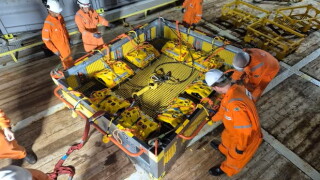
The technology has passed its first phase of qualification, with 84 nodes placed on the seafloor at a depth of 2,000 m to acquire 4D seismic data in the pre-salt Santos Basin.

Chevron and Halliburton describe how they built and deployed the fully autonomous closed-loop fracturing system that enables subsurface-driven optimization.
-
 As tight-oil producers move to curtail production, hard-to-answer questions are being raised about how shuttered wells will come back. The issue reveals key uncertainties about the delicate flow paths that define unconventional reservoirs.
 -
Most history-matching studies have fixed resources—that is, the team of engineers and geoscientists is predetermined. Moreover, the deadlines are always very strict. This constrained scenario often leads to an unfortunate result: The quality of the study suffers.
-
Not everybody suffers when US oil producers slash production. Among the beneficiaries could be US gas producers who will benefit because less oil production will mean a lot less gas on the US market.
-
If design A yields the same 90-day production at 10% lower cost in a series of wells than design B wells, is design A the better one? Using pressure-based fracture measurements, the separability of variables between two completion designs can be evaluated.
-
A downhole compressor solution based on advanced magnetic technologies completed its first field trials in an unconventional gas well. It resulted in a 62% increase in gas production and significant increase in liquid production compared to using a rod pump previously in the well
-
When engineers went searching for clues on how fractures move beneath the surface, they expected to uncover important learnings. They did not know they were on the path to a new invention.
-
Proper lateral and vertical well spacing is critical for efficient development of unconventional reservoirs. Much research has focused on lateral well spacing but little on vertical spacing, which is challenging for stacked-bench plays such as the Permian Basin.
-
Reviewing a myriad of papers presented at different conferences during the past year, I can group the current trends in heavy-oil operations and research into two major categories: Process optimization and use of chemicals as additives to steam and water.
-
Steam-assisted gravity drainage (SAGD) performance in bitumen-recovery projects in Alberta is affected by geological deposits, reservoir quality, and operational experience.
-
Although polymer flooding has become a promising enhanced oil recovery (EOR) technique, no field tests have been performed to date in Alaska’s underdeveloped heavy-oil reservoirs.