Reservoir

This paper documents the testing, integration, and field deployment of a metal expandable packer used as an openhole toe isolation plug in a deepwater well under high-pressure, high-temperature conditions.

Three papers are highlighted as the primary contributions because of their broad industry relevance. They focus on improving formation particle-size characterization, expanding the application of openhole gravel packs in depleted and compartmentalized reservoirs, and advancing the understanding of capillary pressure in sand production.

This paper aims to establish a set of best practices for generating particle-size-distribution data from core samples.
-
 This paper presents a novel sustainable cost-effective method developed to scale up synthesis of Janus carbon nanoparticles from waste plastic feedstock by combined pyrolysis, chemical functionalization, and pulverization.
 -
The authors of this paper describe a model-driven work flow developed for hydraulic fracturing design and execution that could be a resource for other shale plays with similar challenges worldwide.
-
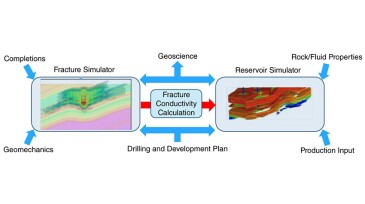
This paper presents a case study of integrated geomechanical and reservoir simulation with a developed fracture conductivity calculation work flow to evaluate well spacing and completions design.
-
In this paper, the authors evaluate the simultaneous optimization of CO2 storage and oil recovery using multiple injection strategies.
-
Oil is the bedrock on which modern society is built. The primary question remains: How can we continue to produce oil while minimizing its climate-harming byproducts? Thanks to the ingenuity of industry professionals around the world, new technologies are emerging that allow us to achieve this goal.
-
The authors of this paper write that computationally coupled models enable swift, accurate, and engineered decision-making for optimal asset development.
-
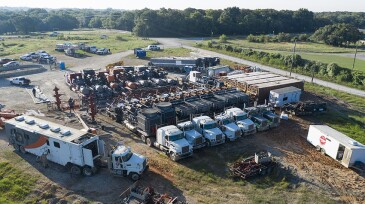
BKV Corp. has combined bullhead and liner refracturing methods to create an approach called the hybrid expandable liner system.
-
AIQ, ADNOC, and SLB announced a new software suite that integrates artificial intelligence into reservoir analysis and field development projects.
-
SponsoredThe Wyoming Gas Injection Initiative (WGII) makes available $22 million of matching funds from the State of Wyoming to implement, in close collaboration with oil and gas operators and Dow, multiple field pilot projects in the State of Wyoming. The Initiative will fund projects over a 3- to 5-year period to support developments with significant potential to enhance wel…
-
The nearly $60-billion deal will see ExxonMobil more than double its Permian Basin output to over 1.3 million BOED.