Unconventional/complex reservoirs

Argentina’s President Javier Milei met with TotalEnergies CEO Patrick Pouyanné and Eni CEO Claudio Descalzi in Paris to discuss Argentina’s energy sector, including projects linked to the Vaca Muerta shale formation and the development of the Argentina LNG export project.

Transaction adds 90,000 net acres and 68,000 BOE/D of production as Crescent expands its South Texas footprint.

This paper aims to establish a set of best practices for generating particle-size-distribution data from core samples.
-
 Hydraulically fracturing and stimulating multiple horizontal wells in sequence has been rapidly adopted by operators because of the potential for production without introducing unwanted risks.
 -
At the Unconventional Resources Technology Conference in Denver, discussion revolved around solving problems below ground and above ground.
-
Matrix acidizing is commonly used as a preflush to the hydraulic-fracturing stimulation of shale formations. The process dissolves sediments and mud solids that inhibit the permeability of the rock, enlarging the natural pores of the reservoir and stimulating flow of hydrocarbons.
-
With the industry moving forward with exploration and development in the broader categories of unconventional resources globally, it is of paramount importance to assess and improve the different methods and tools for estimating reserves, to establish their accuracy and credibility.
-
There are no reliable estimates of technically recoverable resources (TRRs) for unconventional reservoirs outside North Amercia, and many countries lack the advanced technology such as horizontal drilling and hydraulic fracturing necessary to develop unconventional resources.
-
Flowback (or cleanup) of fracturing treatments can have a profound influence on well productivity in unconventional reservoirs. The process of cleanup crosses many discipline boundaries.
-
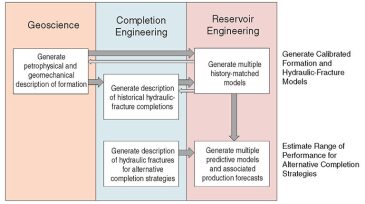
This paper presents a pragmatic integrated work flow used to optimize development and guide critical development decisions in the Black Hawk field.
-
This paper discusses fracture stimulation in the first joint-venture shale-gas project with foreign companies in China.
-
In 2010, exploration of gas-rich and possibly liquid-rich shale reservoirs began in northern Mexico. A two-stage integrated workflow was developed to achieve set objectives.
-
Used extensively by the food, chemical, and pharmaceutical industries, the mechanical-vapor-recompression (MVR) process is viewed as a reliable method for recovering demineralized water from concentrated brines. This paper reports on performance of an advanced MVR system in north-central Texas.