Oilfield chemistry

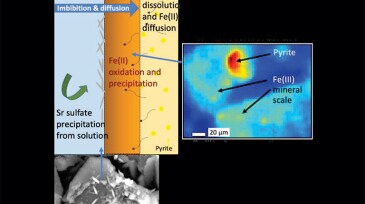
This paper presents an experiment investigating dissolution of basaltic primary minerals and conditions favorable for secondary phase formation under deep subsurface storage conditions.

This study aims to investigate the efficacy of chemical additives strontium chloride and barium hydroxide in accelerating CO₂ trapping mechanisms, their effect on dissolution of carbonate-bearing minerals, and resulting poroelastic changes in the host rock.

This study reviews subsurface microbial activity, biomineralization reactions, and mechanisms prevalent for bioremediating wells, stabilizing cements, and increasing trapping during CO₂ injection and storage.
-
 Friction reducers play multiple critical roles in fracturing. A challenge in selecting the best one for the job is the growing evidence that performance varies, but objective performance measurements are lacking.
 -
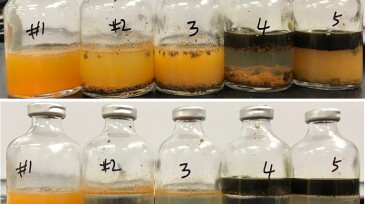
A review of the properties of iron compounds and their impact in shale produced water treatment with an emphasis on their colloidal forms. A wide range of problems is associated with these compounds in produced water including emulsion stabilization, oil-coated solids, pad formation in separators, pipeline solids, and plugging of water disposal formations.
-
The obsession with better hydraulic fracturing has steadily pushed on shale production in year one, but the decline remains steep. Chemistry could help explain, and perhaps extend, the short productive life of these wells.
-
This paper discusses the field implementation of a downhole chemical methodology that has positively affected overall productivity for a mature Kuwait field.
-
The outcome of the authors’ experiments revealed that the tertiary injection of nanoparticles results in additional oil recovery beyond the limit of low-salinity water.
-
SponsoredBefore you pump materials down your well, be sure you fully understand the effectiveness of your friction reducers and gas migration slurries.
-
This paper examines the corrosion-inhibiting properties of several edible stems at downhole conditions with high concentrations of hydrochloric acid. The objective is to present an alternative variety of corrosion inhibitors that are environmentally friendly and nontoxic.
-
The application of an extended-release scale-inhibitor in approximately 70 vertical conventional wells in the Permian Basin has shown approximately three times better performance compared to the incumbent chemical.
-
This latest project will build on a previous initiative with up to a trio of field trials aimed at supporting regulatory authorities and industry to establish new standards and practices for the use of online oil-in-water analyzers at remote locations.
-
With an eye to the future, Interface Fluidics is bringing nanotech to the oil field.