Reservoir characterization
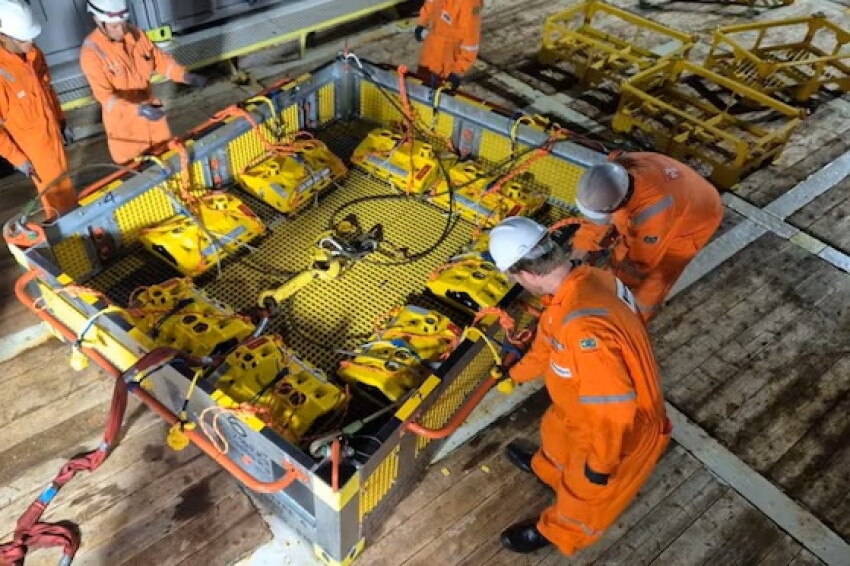
The technology has passed its first phase of qualification, with 84 nodes placed on the seafloor at a depth of 2,000 m to acquire 4D seismic data in the pre-salt Santos Basin.

Xu outlines the thinking and theories that led his team to six world-class oil discoveries that total more than 100 million tons of proven geological reserves since 2021.

This case study from SLB and offshore producer PRIO describes the longest openhole section in Latin America with the highest extended-reach drilling ratio in Brazil’s history.
-
 For this year’s feature, the selected papers provide innovative work flows that assist in determining productivity, reduce the effect of uncertainty conditions, and spark rejuvenation.
 -
A new pulsed-eddy-current (PEC) electromagnetic (EM)-based tool called an enhanced pipe-thickness-detection tool (ePDT) has been introduced for the corrosion inspection of multiple pipes.
-
Merging tried-and-true physics-based models with data science is bolstering the Houston independent’s reservoir-engineering work on its deepwater and shale assets.
-
Wireline formation tests are a critical piece of the exploration and appraisal process, yet they come with a degree of uncertainty. The supermajor has tapped a new software developer to see if it can clear things up.
-
While some try to put the two enormous oil producers toe-to-toe, the best thing to do might be to understand why they are different.
-
To enhance the applicability of localization to various history-matching problems, the authors adopt an adaptive localization scheme that exploits the correlations between model variables and observations.
-
A challenging problem of automated history-matching work flows is ensuring that, after applying updates to previous models, the resulting history-matched models remain consistent geologically.
-
This paper presents a work flow to match the history of reservoirs featuring complex fracture networks with a novel forward model.
-
Data volumes are growing at an exponential rate. How can high-performance computing solutions help operators manage these volumes? Will faster, stronger processors and cloud computing solutions be the answer?
-
This paper describes interpretation results of a 4D seismic-monitoring program in a challenging Middle East carbonate reservoir.