Reservoir characterization
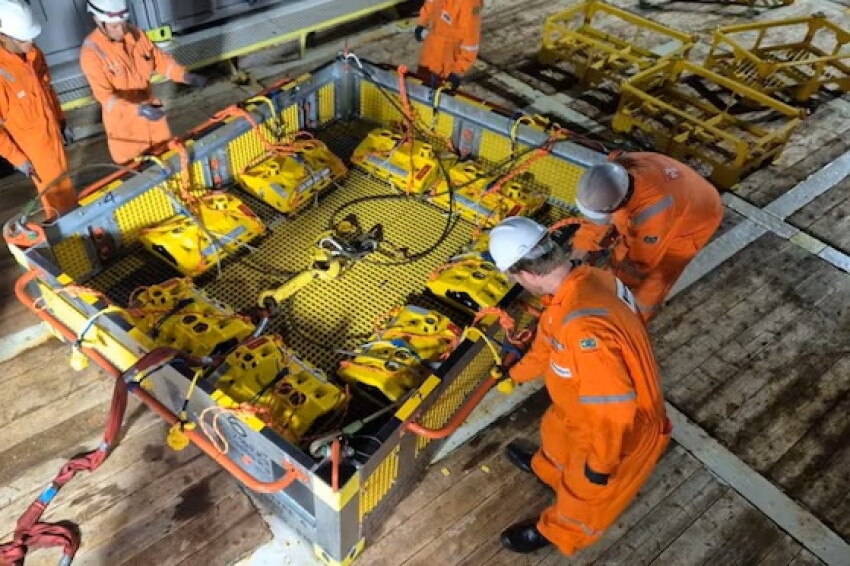
The technology has passed its first phase of qualification, with 84 nodes placed on the seafloor at a depth of 2,000 m to acquire 4D seismic data in the pre-salt Santos Basin.

Xu outlines the thinking and theories that led his team to six world-class oil discoveries that total more than 100 million tons of proven geological reserves since 2021.

This case study from SLB and offshore producer PRIO describes the longest openhole section in Latin America with the highest extended-reach drilling ratio in Brazil’s history.
-
 This paper discusses a project with the objective of leveraging prestack and poststack seismic data in order to reconstruct 3D images of thin, discontinuous, oil-filled packstone pay facies of the Upper and Lower Wolfcamp formation.
 -
Production growth in the Permian Basin requires drill rigs running at a high pace. That is challenging companies to push well productivity.
-
Electromagnetic images can show where water flows during a hydraulic fracture. A test in the Anadarko Basin showed a fault there was a bigger hazard than expected.
-
Diagnostic fracture injection tests (DFITs) incur direct and indirect costs resulting from the tests themselves and the extended time required for the pressure falloff, which delays the completion of the well. The benefits, therefore, must outweigh the costs if the test is to be justified.
-
Using drilling data and a downhole acoustic signal, developers aim to assess unconventional fracture networks in real time and give engineers ability to customize each stage.
-
BP announced four discoveries in the Gulf of Mexico near existing platforms. It use advanced seismic imaging to identify resources in deepwater locations that can be developed cost effectively using platforms nearby.
-
This paper describes a case study of the Chonskaya group of fields to demonstrate an approach to the integration of time-domain-electromagnetic (TDEM) electrical and seismic data when building a geological model for improving reservoir-property and -saturation prediction.
-
This paper presents an interdisciplinary approach to the description of tectonic dislocations made on the basis of interpretation of seismic data, petrophysical analysis of well-logging data in horizontal wells, and inversion of a multifrequency propagation tool.
-
In the clustered-development approach, the geologic dependence between prospects is combined with the aggregation of prospects to determine the economic viability of a grassroots development offshore.
-
The upcoming event will provide the shale sector with a venue to share new learnings and approaches meant to overcome one of its greatest subsurface challenges.