Reservoir simulation

This paper presents a case study from a mature field redevelopment project where pulsed neutron logging was integrated with advanced reservoir modeling to improve the understanding of fluid-contact dynamics and optimize new horizontal well placement.

This paper aims to showcase examples of how integrated analysis of surveillance data in the Azeri-Chirag-Gunashli field has improved reservoir understanding and informed reservoir-management decisions.

This work applies fuzzy logic, a well-established artificial-intelligence technique, to quantitatively assess connectivity between injectors and producers in a giant presalt field in the Santos Basin of Brazil.
-
 The complete paper discusses the advancements in mud-displacement simulation that overcome the limitations of the previous-generation simulator and provide a more-realistic simulation in highly deviated and horizontal wells.
 -
Researchers: Models Overstate Technology Impact, Understate Location Impact for Unconventional WellsTwo researchers at the MIT Energy Initiative have found that current modeling overestimates the impact of new technology on unconventional well productivity and underestimates that of increasingly targeting reservoir “sweet spots.”
-
Nearly a decade after an SPE meeting in Bruges set industry-inspiring benchmarks for reservoir modeling, the time has come to overcome a new set of challenges.
-
Conventional inflow-performance-relationship (IPR) models are used in coupled wellbore/reservoir transient simulations, even if bottomhole-pressure conditions are assumed to be constant on the derivation of such IPR models.
-
Because of their heterogeneity, carbonate reservoirs are more difficult to model than clastic reservoirs. The main difficulty comes from the number of different pore types, compared with the typical interparticle pore type in clastics.
-
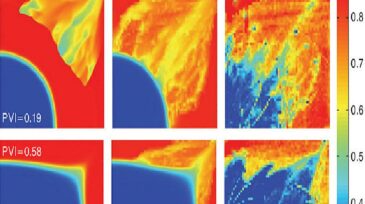
This paper addresses the challenges in modeling highly unstable waterflooding, using both a conventional Darcy-type simulator and an adaptive dynamic prenetwork model, by comparing the simulated results with experimental data including saturation maps.
-
A fast, integrated reservoir modeling tool used by Eni at Norway’s Goliat field generated an ensemble of models that helped confirm the location of previously identified infill drilling targets and identify several new infill locations.
-
A critical step in proper design and optimization of any chemical-enhanced-oil-recovery (CEOR) process is appropriate and precise numerical simulations.
-
This study explores the mechanisms contributing to oil recovery with numerical modeling of experimental work and investigates the effects of various parameters on oil recovery.
-
This paper describes the first job in southeast Asia in developing horizontal-well placement in a turbidite environment.