Reservoir simulation

Known as Arena, the collaboration aims to improve decision-making across increasingly complex reservoirs and growing volumes of subsurface data.
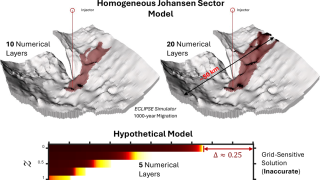
A new framework combines analytical and numerical insights, extending vertical equilibrium modeling and guiding reservoir-scale implementation, providing reservoir engineers with practical guidance for assessing accuracy across flow regimes and long-term carbon-dioxide migration.

This article from the SPE Integrated Reservoir Management Technical Section (IRMTS) examines the closed-loop IRM approach, from insight to execution to learning, and the limits of technology-driven solutions.
-
 The aim of this work is to present the effectiveness of a fully integrated approach for ensemble-based history matching on a complex real-field application.
 -
One unfortunate consequence of a base-case model, however, is the risk of an anchoring effect, in which case we may underestimate uncertainty. Essentially, the anchoring effect refers to our tendency to rely too heavily on the information offered, introducing a bias in the model-construction process
-
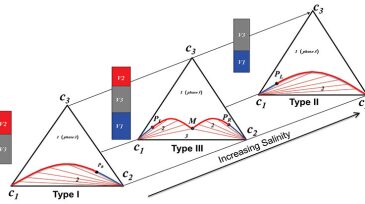
The complete paper presents a new three-phase relative permeability model for use in chemical-flooding simulators.
-
The complete paper discusses the advancements in mud-displacement simulation that overcome the limitations of the previous-generation simulator and provide a more-realistic simulation in highly deviated and horizontal wells.
-
Researchers: Models Overstate Technology Impact, Understate Location Impact for Unconventional WellsTwo researchers at the MIT Energy Initiative have found that current modeling overestimates the impact of new technology on unconventional well productivity and underestimates that of increasingly targeting reservoir “sweet spots.”
-
Nearly a decade after an SPE meeting in Bruges set industry-inspiring benchmarks for reservoir modeling, the time has come to overcome a new set of challenges.
-
Conventional inflow-performance-relationship (IPR) models are used in coupled wellbore/reservoir transient simulations, even if bottomhole-pressure conditions are assumed to be constant on the derivation of such IPR models.
-
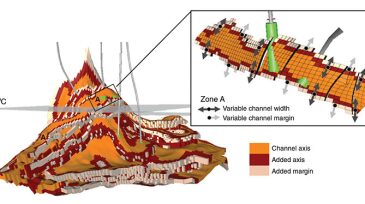
Because of their heterogeneity, carbonate reservoirs are more difficult to model than clastic reservoirs. The main difficulty comes from the number of different pore types, compared with the typical interparticle pore type in clastics.
-
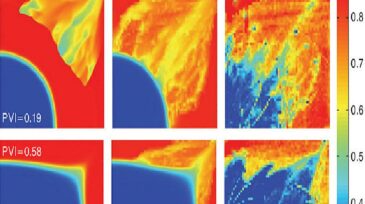
This paper addresses the challenges in modeling highly unstable waterflooding, using both a conventional Darcy-type simulator and an adaptive dynamic prenetwork model, by comparing the simulated results with experimental data including saturation maps.
-
A fast, integrated reservoir modeling tool used by Eni at Norway’s Goliat field generated an ensemble of models that helped confirm the location of previously identified infill drilling targets and identify several new infill locations.