Reservoir

A report commissioned by Havtil, the Norwegian Ocean Industry Authority, calls for better dialogue regarding pore-pressure uncertainty and higher-end drilling techniques like managed pressure drilling as methods to reduce the risk of well-control events.
The events will be co-located 3–5 May 2027 at Reliant Park in Houston, Texas.

This work describes a study in which distributed data parallel training, paired with a node-local caching pipeline, enabled efficient multigraphics-processing-unit scaling for a CO₂-storage graph-neural-network surrogate while maintaining generalization.
-
 This paper presents key challenges in surface-facilities-project implementation during the construction and operational-readiness phase of a project and presents results from full-field implementation.
 -
This paper provides an overview of all enhanced-oil-recovery (EOR) projects in the Greater Prudhoe Bay (GPB) region and presents the process and methodology for MI allocation to these projects and to individual injection patterns.
-
The implementation of chemical EOR has proven successful but the method faces significant technical and financial challenges.
-
This paper presents a critical review of the recent literature to determine the status of research and development and field application of nanotechnology in the oil field.
-
This paper will describe how one integrates a comprehensive methodology of data-mining techniques and artificial neural networks (ANNs) in reservoir-petrophysical-properties prediction and regeneration.
-
Three major finds have shattered assumptions about what is possible in the most explored parts of Alaska’s North Slope.
-
A fast, integrated reservoir modeling tool used by Eni at Norway’s Goliat field generated an ensemble of models that helped confirm the location of previously identified infill drilling targets and identify several new infill locations.
-
We report a novel type of viscosity modifier relying on the supramolecular assemblies that have pH-adjustable viscosities and robust tolerance against high temperatures and salinities, and are resistant to shear-induced degradation.
-
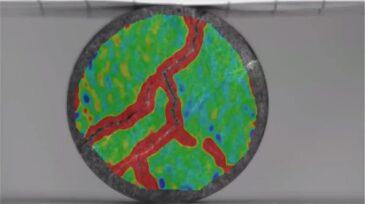
Technology that allows researchers to see stress forming inside rock samples may help unravel some of the mysteries associated with fracture behavior.
-
Getting a good well for a field test can make or break a new idea. A government backed research group in Saskatchewan is offering up to CAD 100,000 break on royalty payments to test ways to extend the life of conventional, heavy-oil fields.