Unconventional/complex reservoirs

Argentina’s President Javier Milei met with TotalEnergies CEO Patrick Pouyanné and Eni CEO Claudio Descalzi in Paris to discuss Argentina’s energy sector, including projects linked to the Vaca Muerta shale formation and the development of the Argentina LNG export project.

Transaction adds 90,000 net acres and 68,000 BOE/D of production as Crescent expands its South Texas footprint.

This paper documents the testing, integration, and field deployment of a metal expandable packer used as an openhole toe isolation plug in a deepwater well under high-pressure, high-temperature conditions.
-
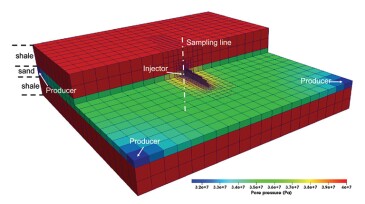
 This paper introduces methods to fully couple reservoir simulation with wellbore flow models in fractured injection wells.
-
A rigless chemical frac-hit remediation process was designed to address the damage mechanisms of capillary phase trapping, reduced hydrocarbon relative permeability, paraffin deposition, and minor scale deposition.
-
The disruptive nature of unconventional reservoirs has spurred the need for new ideas. But that doesn’t always mean that we need to toss out the traditional methods that got us here. Such might be the case for the recent developments unfolding around the diagnostic fracture injection test (DFIT).
-
The paper demonstrates the ability of deep-learning generative models to enable new shale-characterization methods.
-
A new dose of constraint may just be the best prescription for those making reserves estimates on prospective unconventional resources.
-
The paper presents a model for shale gas production in which CO2 is injected by huff ’n’ puff into a hydraulic fracture surrounded by a shale matrix.
-
This study explores pitfalls experienced when using capacitance/resistance modeling as a plug-and-play technique for waterflood optimization and discusses workarounds and mitigations to improve its reliability.
-
Natural gas delivered as LNG to growing economies in Asia has a strong role to play in achieving net zero in carbon emissions, and most of that gas will come from unconventional resources.
-
The newly formed SPE Hydraulic Fracturing Technical Section is working on a project to identify a set of best practices for completions engineers. Once completed, they will be accessible to the entire SPE technical community.
-
Mixing dry polymer powder and water to make friction reducer as needed during fracturing can cut the cost of the additive and the testing of whether a drastically simplified recipe performs as well as more-complex mixes.